
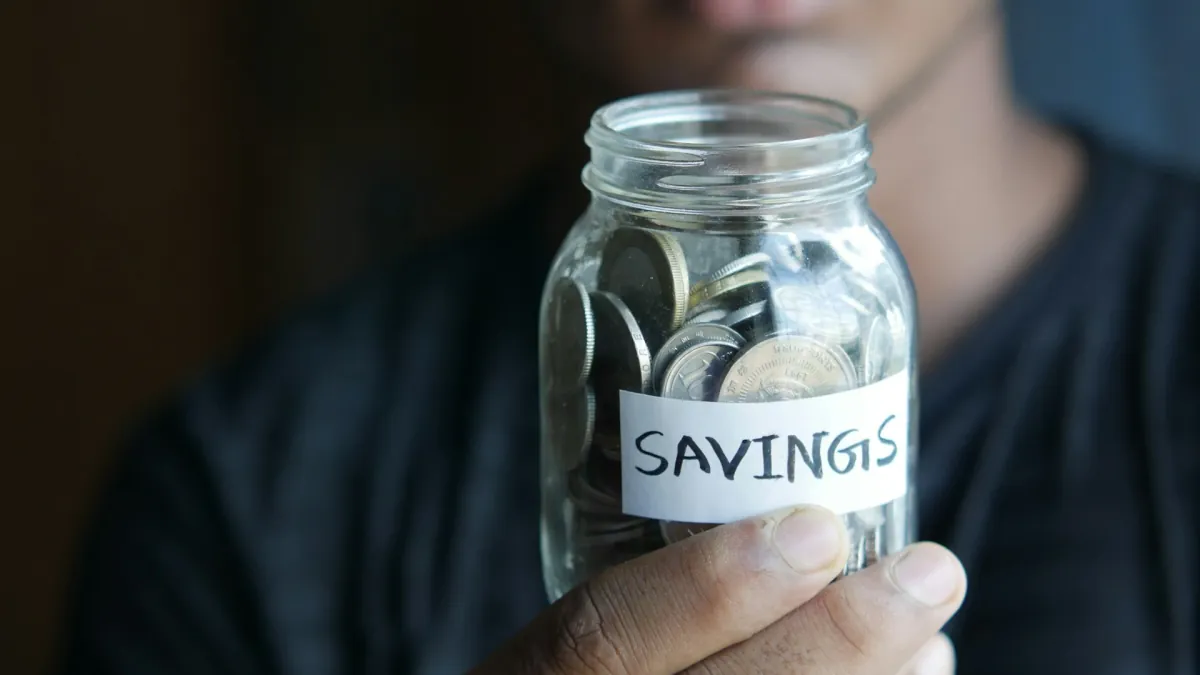
The coffee craving has already passed, but the mason jar is still empty and the pen-and-paper log has no proof that you chose future rent over another small treat.
A jar alone does not save money — what does is the $5 pretend-spending redirect, $20–$50 weekly cap, named sinking jars, pay-yourself-first automation, monthly count, HYSA bridge, and Coinstar 11.9% fee check operating together.
Detailed expense tracking can still end with $400 in checking by payday — because tracking without a redirect system gives a cleaner view of the same hole, not a way out of it.
The 12-lever framework, six-profile jar-saver decision tree, and eight-step toolkit — mason labels, pen-paper logs, auto-splits, Ally Buckets, HYSA migration, FDIC rules, 988 for financial stress, and money saving challenges that pair with jar milestones — are all below.
A jar is the cash-only entry into Money Saving Challenges, the parent framework that names which structured formats fit which paychecks. The peer formats — the printable money saving challenge and the 1-100 money saving chart — extend the jar's concept with row-based deposit ledgers and total-saved targets.
The 12-Lever Save-Money-Jar Framework
Benchmarks from the Bureau of Labor Statistics Consumer Expenditure Survey shows the lowest-income quintile allocates roughly 8% of spending to food away from home — small, repeated purchases that jar savers can redirect.
| # | Lever | Action | Source |
|---|---|---|---|
| 1 | Pretend-spending redirect | Drop $5 in jar every time an impulse buy is skipped | CFPB the CFPB |
| 2 | Physical jar as visible cue | Use a clear mason jar so progress is visible daily | CFPB consumer-tools/educator-tools/your-money-your-goals |
| 3 | Weekly cap rule | Cap jar deposits at $20–$50/week to prevent overdoing it | CFPB your-money-your-goals/toolkit |
| 4 | Pen-and-paper log | Log date, amount, reason, running total in a notebook | CFPB the CFPB |
| 5 | Loose-change + $5-bill rule | Add all loose change and every $5 bill that lands in your wallet | — |
| 6 | Named-goal jar | Label the jar with a specific goal (Hawaii, car repair, Christmas) | — |
| 7 | Multi-jar sinking system | Run 3–7 jars labeled emergency / vacation / gifts / car / pet | CFPB an-essential-guide-to-building-an-emergency-fund |
| 8 | Pay-yourself-first automation | Set up a recurring transfer to savings BEFORE the jar | CFPB whats-the-difference-between-direct-deposit-and-automatic-payment-en-1023 |
| 9 | Plaid auto-split 10–15% | Split 10–15% of each paycheck to HYSA via Plaid auth | Plaid |
| 10 | Ally Buckets named after jar | Name a savings bucket after each jar goal in Ally | Ally |
| 11 | HYSA bridge when jar hits $100 | Transfer jar balance to HYSA (4–5% APY) when it reaches $100 | FDIC the FDIC |
| 12 | Lifestyle-creep bank 50% | When income rises, bank 50% of the raise before spending | Federal Reserve the Federal Reserve |
If four months of careful expense tracking still ends with the broke feeling, Lever 1 is missing — the impulse got logged but never redirected. The jar converts the same discipline into a physical deposit.
6-Tier Jar-Saver Tree: Single, Couple, Family, Emergency, Christmas, and Kids
Calculations from the SEC compound interest calculator shows a $5/day deposit earning 4.5% APY grows to roughly $1,985 (about $5 × 365 × 1.045^0.5) in the first year when transferred monthly to an HYSA.
| Tier | Profile | Jar setup | Weekly target | Bridge |
|---|---|---|---|---|
| 1 | Single-starter | 1 jar, $5/day pretend-spend + loose change | $20–$35 | HYSA at $100 |
| 2 | Couple-joint-goal | 1 shared jar + Sunday review session | $35–$50 combined | Joint HYSA bucket |
| 3 | Family multi-jar | 5–7 jars: emergency / vacation / gifts / car / pet / holiday | $50–$80 | Ally Buckets per goal |
| 4 | Emergency-only | 1 jar → HYSA $1,000 starter fund only | $20–$40 | FDIC-insured HYSA |
| 5 | Gift/Christmas prep | Start in January at $10/week → $520 by December | $10 | Ally Buckets "Christmas" |
| 6 | Kids-allowance trainer | Save / Spend / Share 3-jar split + $1/year-of-age allowance | Varies | Kids savings account |
The CFPB's emergency fund guide recommends 3–6 months of expenses; Tier 4 treats the jar as the $1,000 on-ramp to that target.
8-Step Jar Toolkit: Mason Labels, Pen-Paper Log, Auto-Split First, Buckets, HYSA, Monthly Count, and Dropout Reset
- Mason labels — Write goal + target amount on a piece of tape on each jar. Clear glass = visible progress.
- Pen-paper log — Date, amount, reason, running total. One line per deposit. No app required.
- Plaid auto-split FIRST — Before touching the jar, route 10–15% of every paycheck to HYSA automatically via Plaid.
- Ally Buckets — Mirror each jar label as an Ally savings bucket so the HYSA bridge is pre-named.
- HYSA transfer — When any jar hits $100, transfer to the matching Ally bucket. Current HYSA APY: 4–5%.
- Mint/YNAB/Monarch — Sync accounts to catch subscriptions you forgot about; the gym membership you stopped using is worth more in the jar.
- Monthly count + Coinstar check — Count coins on the 1st of each month. If using Coinstar, its fee is 11.9% of the coin value. Rolling coins or depositing at your own bank costs nothing.
- Dropout reset — If you skip a week, restart immediately. FDIC-insured HYSA up to $250,000; NCUA-insured credit union shares up to $250,000.
How Much of My Paycheck Should Go Into the Jar Before Spending?
The jar is a visible, physical layer — not a replacement for automation. The sequence matters: (1) pay-yourself-first transfer 10–15% via Plaid before spending; (2) then deposit $5 per skipped impulse into the jar throughout the week; (3) cap jar inflows at $20–$50/week so the habit stays sustainable. For a take-home pay of $3,000/month, the automation handles $300–$450 first, and the jar adds $80–$200 on top of that. The CFPB best ways to save moneying tool suggests tracking every inflow and outflow to see which cap works for your pattern.
Set up your automatic transfer before you deposit a single dollar in the jar.
How Do I Save Money and Pay Down Debt With Kids Asking for Cash?
Every single day, kids want ice cream, apps, or a $1 treat — the pressure is real and compounds quickly. Two levers contain it without the "we can't afford it" conversation. First, give each child a 3-jar system (Spend / Save / Give) plus $1 per year of age per week as an allowance; the jar becomes the answer when they ask, not your wallet. The CFPB's Money as You Grow resource has free age-by-age guidance for this.
Second, run the debt-avalanche (pay the highest-rate debt first) in parallel with the jar habit — the jar builds the $1,000 emergency buffer so a car repair doesn't break the debt payoff plan. A $200 impulse redirected into the jar for 5 weeks covers the most common emergency copay without touching the credit card.
Use the kids' jar conversation to explain, not to refuse.
Money Saving Jar DIY: How to Build a Jar That Forces a Deposit
A jar that forces a deposit has one design rule: the opening must require deliberate action. Tape a paper slot label over the lid of a wide-mouth mason jar so you have to lift the label to put money in — that micro-friction makes the deposit feel intentional, not automatic. Label the outside with: goal name, target amount, and a progress bar drawn in marker.
| Item | Function | Where to find |
|---|---|---|
| Wide-mouth mason jar (quart) | Visibility + capacity | Walmart, Amazon — search "save money jar walmart" |
| Paper label + marker | Goal name + progress bar | Dollar store |
| Rubber band slot insert | Forces coin-slot deposit action | DIY from cardstock |
| Lid with a slot cut in | Makes deposit intentional | Repurpose any plastic lid |
What Is the 3 Jar Rule, and When Do Adults Need More Than 3?
The 3-jar rule — Spend / Save / Give — is a children's budgeting baseline. For adults, 3 jars are enough only for Tier 1 (single-starter with one goal). Most adults need 5–7 jars: emergency, vacation, gifts, car repair, pet, and a holiday fund. The multi-jar sinking system (Lever 7) mirrors Ally Buckets so every jar has a named digital counterpart. If you find yourself raiding the vacation jar for car repairs, you need separate jars — the CFPB emergency fund guide recommends keeping emergency funds completely separate from goal funds.
Rename your jars now — the name creates the commitment.
How Often Should I Add Money to the Jar Before Moving It to HYSA?
Add money to the jar every time you skip an impulse purchase — that is daily for most people. Move it to HYSA when the jar hits $100, not on a fixed calendar. A fixed calendar (e.g., monthly) means some months the jar sits at $300 earning nothing; the $100 trigger keeps the HYSA compounding. FDIC national rate data shows HYSA rates at 4–5% APY for major online banks (Marcus, Discover, Ally, Capital One, SoFi) as of early 2026. At 4.5% APY on $100 transferred monthly, the HYSA earns roughly $4.50/year on that tranche alone — small, but it accumulates every transfer.
Count coins on the 1st of each month and transfer the full jar balance to HYSA that same day.
What CFPB, FDIC, NCUA, BLS, Federal Reserve, the SEC investor portal, and FTC Data Say About Jar Habits
| Agency | Key data point | Implication for jar savers |
|---|---|---|
| CFPB | Budgeting tools + pay-yourself-first guidance | Lever 1 (redirect) and Lever 8 (automation) are evidence-based |
| FDIC | HYSA national rates 4–5% APY | Jar bridge to HYSA beats 0.01% checking APY |
| NCUA | Credit union share insurance $250K | Credit union savings accounts are equally insured alternatives |
| BLS CEX | Lowest quintile spends ~8% on food away from home | Even $5/day redirect from that category funds a real jar |
| Federal Reserve G.19 | Consumer credit grows with income gains | Lifestyle creep (Lever 12) is backed by Fed borrowing data |
| the SEC investor portal | Compound interest calculator | $5/day at 4.5% for 5 years = about $10,150 (formula: $5 × 365 × [(1.045^5 − 1)/0.045]) |
| FTC | Coinstar 11.9% fee disclosure | Roll your own coins or deposit at your bank — the fee erases gains |
What Banks, Buckets, Fintechs, and Tracking Apps Add to the Jar System
| Source type | Tool | What it adds |
|---|---|---|
| Bank — HYSA | Marcus, Discover, Ally, Capital One, SoFi | 4–5% APY on transferred jar balance |
| Fintech — auto-split | Plaid auth | Routes 10–15% of paycheck to HYSA before the jar |
| Bank — named buckets | Ally Buckets | Mirrors each jar label as a digital savings bucket |
| Tracking — free | Mint, YNAB, Monarch | Catches forgotten subscriptions the jar won't cover |
| Marketplace — jar | Walmart, Amazon | Wide-mouth mason jars from $2–$8 |
None of these tools replace the pen-and-paper log — they sit on top of it. The log is the discipline; the apps are the optimization layer.
Why Coinstar 11.9% Fees Must Be Checked Before the Monthly Count
Coinstar charges 11.9% of the total coin value as a cash redemption fee. On a $50 jar of coins, that is $5.95 gone — equivalent to more than one day's pretend-spending redirect wiped out by the fee. The fix is free: roll coins at home using paper coin rolls (most banks give them away), deposit the rolls at your bank or credit union, or select a Coinstar gift card option (some gift card exchanges charge no fee). Check the fee option every time — Coinstar's no-fee gift card partners change periodically.
Never redeem coins for cash at Coinstar without checking the no-fee gift card alternative first.
FAQ
How much of my paycheck should I put into savings via a jar?
The jar is a supplement, not the main vehicle. Automate 10–15% of take-home pay to an HYSA first (Lever 8–9). Then deposit $5 per skipped impulse into the jar, capped at $20–$50/week. On a $3,000/month take-home, automation handles $300–$450 and the jar adds $80–$200 on top. Set up the automation on payday so the jar is always a bonus, not the plan.
Can I use a save money jar for kids and adults at the same time?
Yes — run separate jars by role. Adults use the 12-lever system with an HYSA bridge. Kids use the 3-jar Spend / Save / Give split with $1/year-of-age weekly allowance. Keep the jars physically separate so kids see their own progress and adults do not raid the kids' jar. Label every jar with the owner's name and goal.
Where do I find a good save money jar near me or online?
Wide-mouth quart mason jars at Walmart cost roughly $2–$4 each. Amazon carries the same jars in 12-packs for about $18–$24. The jar does not need to be decorative — clear glass and a tight lid are the only functional requirements. Save money jar with lid is the right search term at both retailers. Buy the plain version; spend the decoration budget on a good marker for labeling goals.
What is the money saving jar challenge, and how does it work?
A money saving jar challenge is a time-boxed version of the jar habit. Common formats: $5/week for 52 weeks ($260 total), $1/day for 30 days ($30), or the coin-saving money jar challenge where every coin collected for 90 days goes into the jar. The challenge format adds a deadline and a visible finish line. Pair any challenge format with the HYSA bridge so coins and bills earn interest between monthly counts.
Conclusion
A save-money jar works when it runs the full 12-lever system — not just a mason jar on the counter. The pretend-spending redirect converts impulse buys into deposits; the 6-tier tree tells you how many jars you actually need; the 8-step toolkit operationalizes mason labels, pen-paper logs, Plaid auto-splits, Ally Buckets, and the HYSA bridge before Coinstar fees erase your count.
In the next 24 hours: label one clear mason jar with a specific goal and a dollar target, log your first $5 deposit with today's date, and schedule an automatic $50 transfer to an HYSA for your next payday. Three actions. That is the complete starter system.
A labeled jar with a goal, a $5 redirect habit, and an HYSA bridge at $100: that three-part sequence turns a mason jar into a sinking fund that actually closes. The $5 is not the point — the redirect becoming automatic is.